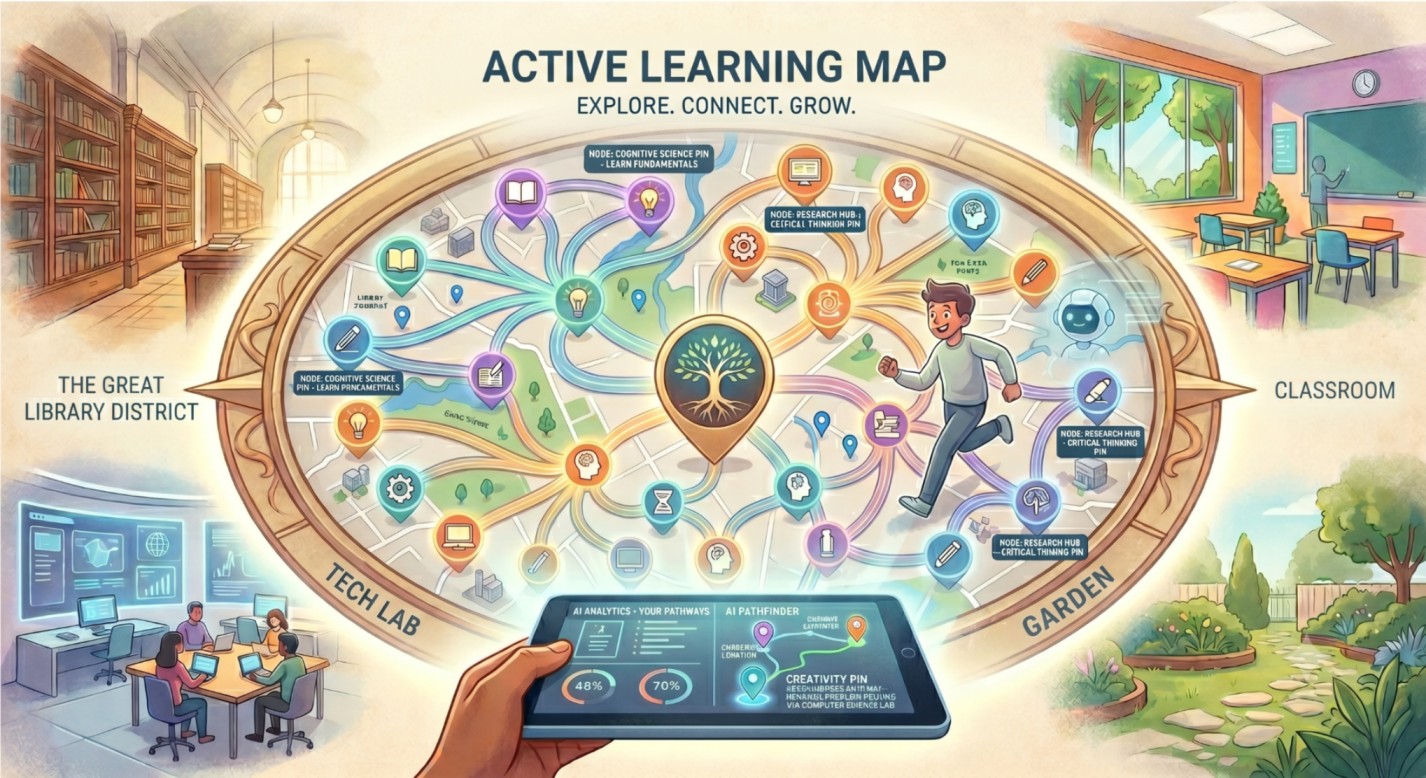
Traditional education often treats learning as a straight line—a rigid checklist of lectures and exams that assumes every student progresses at the exact same pace. But in reality, true human learning is non-linear, unpredictable, and deeply personal, filled with sudden cognitive leaps and variable moments of assimilation. To capture this dynamic reality, my research introduces a data-driven framework centered around the Active Learning Map.
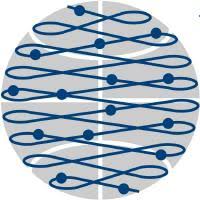
Instead of tracking simple grades, this system maps a student’s evolving knowledge state as a continuous trajectory through a high-dimensional vector space called Polylines. Using a radial mapping algorithm, these complex mathematical dimensions are compressed into an intuitive, two-dimensional coordinate system where each fundamental course topic radiates as its own axis from a central origin.
By integrating a Conditional Generative Adversarial Network (cGAN) to simulate how a student’s knowledge profile changes when they interact with a resource, we’ve built a highly accurate transition state model. Navigating this space is an intelligent, model-free Deep Q-Network (DQN) recommendation engine. Operating much like a GPS for education, the AI agent treats curriculum routing as a shortest-path problem, dynamically discovering personalized, accelerated learning trajectories to close the knowledge gap and guide students toward mastery in the fewest possible steps. By turning abstract cognitive growth into a visually interpretable and traversable landscape, the Active Learning Map lays the groundwork for a truly adaptive, outcome-centric classroom.