
Multi-Modal Mobility Solutions for Megaregions around Bengaluru

Unlocking Mobility to Improve Urban Life in Bengaluru

Bengaluru faces one of the most severe traffic congestion challenges in India. Rapid population growth, economic expansion and increasing vehicle ownership have placed immense pressure on the city’s transport infrastructure. Daily gridlock has become a defining feature of urban life, leading to longer commute times, higher air pollution, reduced productivity, and a declining quality of urban life.
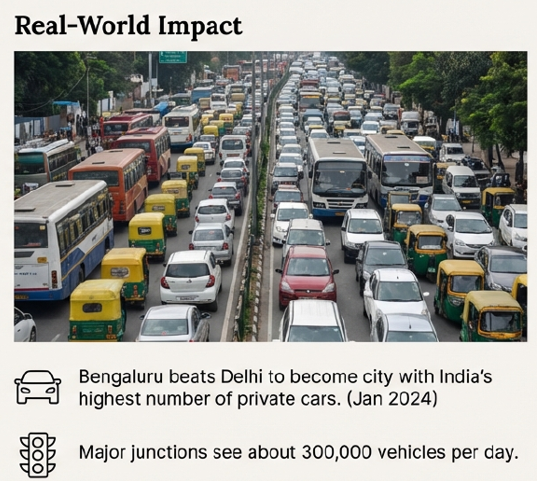
Recognizing that conventional solutions such as road widening and flyovers cannot resolve these systemic challenges, Bengaluru requires a more integrated, forward-looking approach to mobility one that goes beyond city limits and addresses regional travel patterns.

Rethinking Mobility for a Growing Megaregion

To respond to this challenge, we are developing a transformative initiative:

Project Title: Multi-Modal Mobility Solutions for Megaregions around Bengaluru

Once known as the Garden City and now India’s technology capital, Bengaluru has grown rapidly over the past five decades. While this growth has brought innovation, talent, and economic opportunity, it has also resulted in stressed infrastructure, fragmented transit systems, congestion, climate pressures, and limited freight capacity. Addressing these challenges requires moving beyond the scale of a single city.

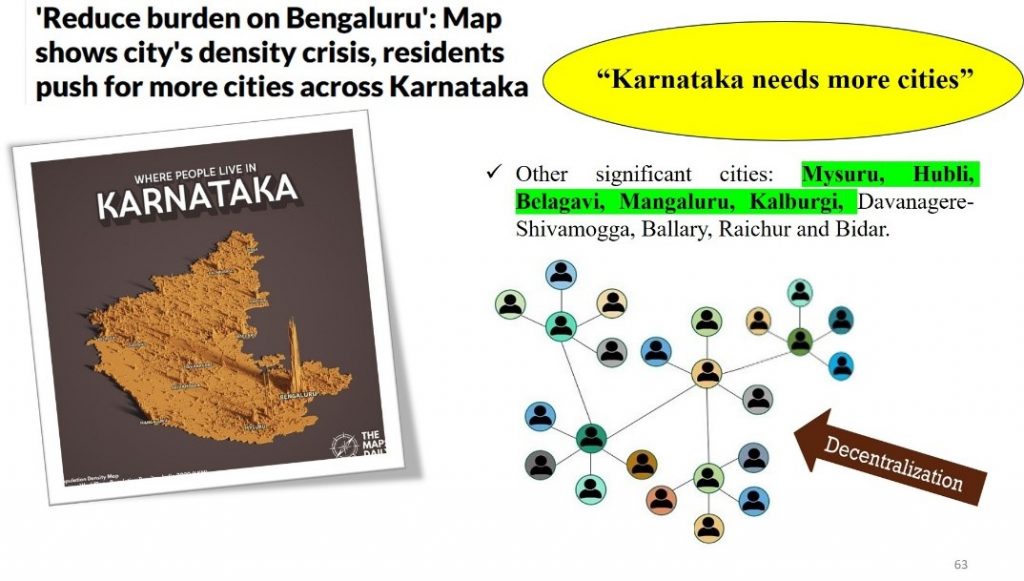
Across Karnataka, population and economic activity are spreading unevenly, with new growth centers emerging beyond Bengaluru’s urban core. In this context, megaregional planning and multi-modal mobility offer a new paradigm for sustainable development.
What Is a Megaregion?

A megaregion is a large, networked geographic area that extends beyond individual cities and administrative boundaries. It is formed by multiple interconnected growth centers that are economically and functionally interdependent, collectively driving regional and national development.

The Bengaluru megaregion extends well beyond the city’s current periphery, encompassing emerging centers, each with distinct strengths and development potential. As growth increasingly clusters across these locations, mobility planning must evolve to treat the region as a single, integrated system.
Data-Driven Planning for Integrated Connectivity

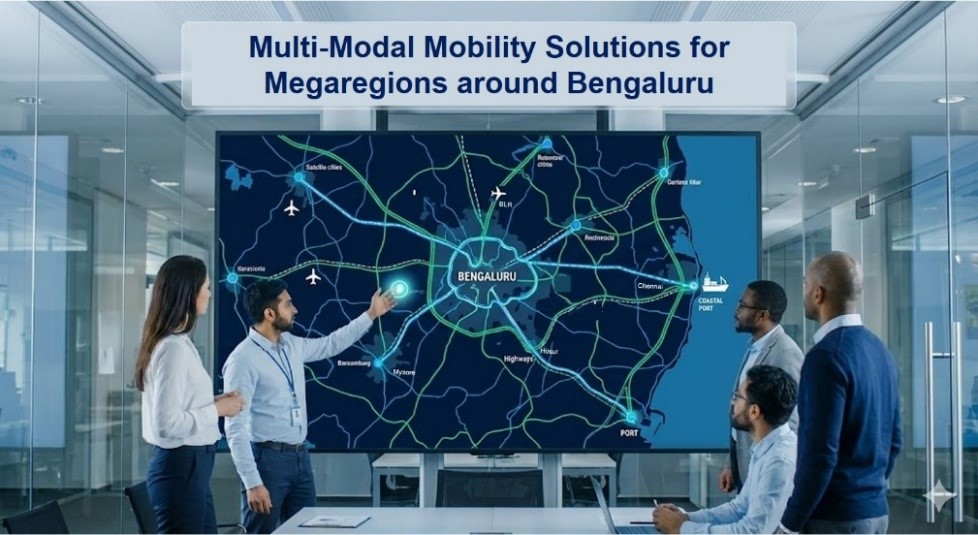
Understanding travel demand, growth corridors, and inter-city linkages enables smarter, more resilient mobility planning. Improved regional connectivity through suburban rail, metro systems, highways, regional rapid transit systems, high-speed rail proposals (such as the Chennai–Mysuru corridor), and shared mobility can activate new economic nodes, strengthen rural–urban integration, and distribute opportunities more evenly across the state.

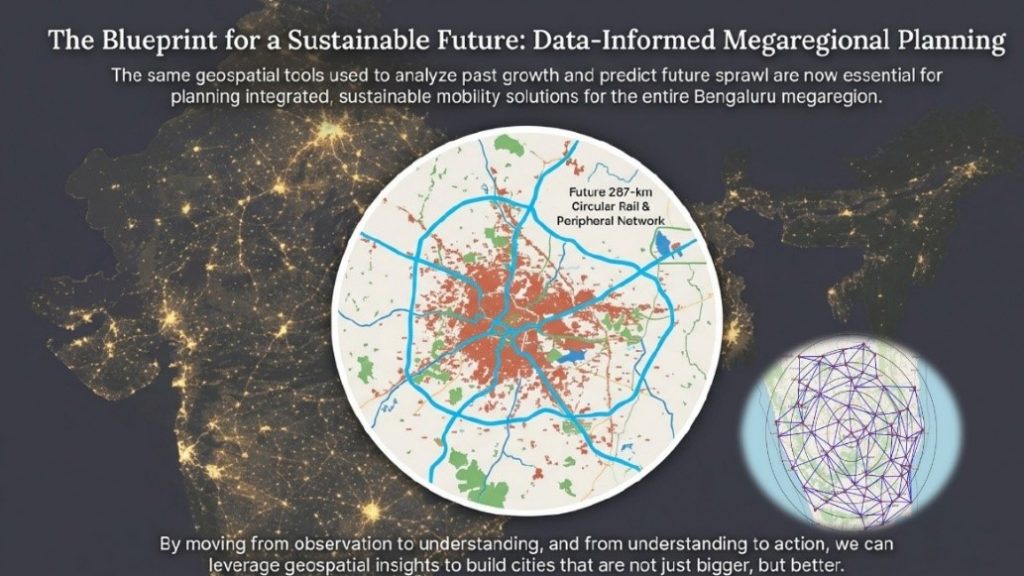
This project leverages satellite imagery, geospatial analytics, night-time lights data, transport network modeling, and real-time mobility insights to delineate megaregional boundaries, anticipate future growth patterns, identify strategic mobility corridors, and propose integrated, multi-modal transport solutions.
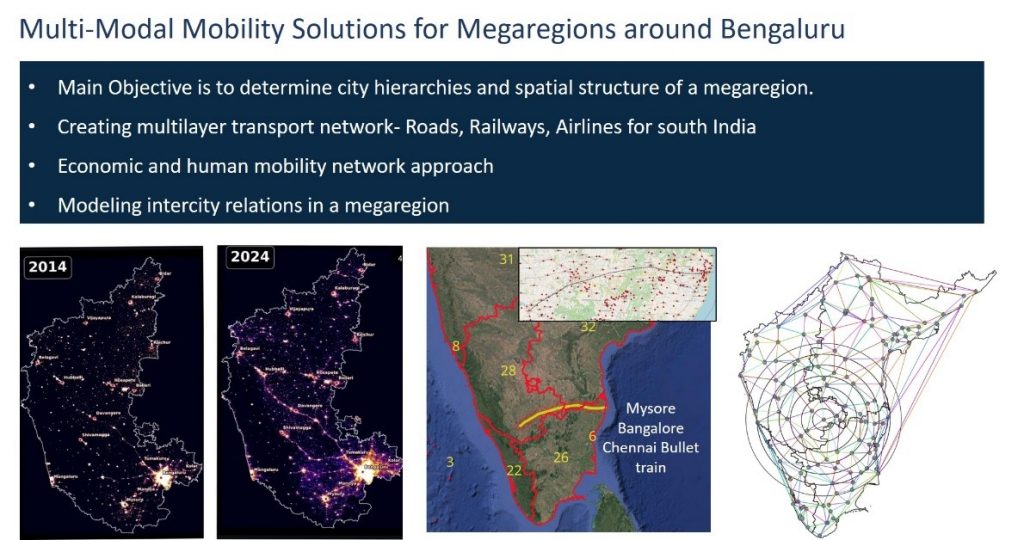
By enabling efficient, low-carbon movement of people and goods, a balanced network of cities can reduce migration pressures on Bengaluru, ease congestion, and support more livable, resilient communities across megaregion.

Aligning with National and Regional Vision

This initiative aligns closely with Viksit Bharat 2047, supporting sustainable, inclusive, and intelligent urban and regional development. Megaregional planning opens new pathways for investment, industry, innovation, and equitable access to opportunity.

Stronger connectivity between Bengaluru and small and medium towns can foster diversified economic growth, reduce pressure on the capital, and enhance quality of life across the region. The study of megaregional mobility is more than a research effort, it is a long-term vision for balanced, sustainable growth.
The study of megaregional mobility is enabled by Bengaluru Science and technology (BeST) Cluster (https://www.bestkc.in/), an initiative by the Office of the Principal Scientific Adviser to the government of India.
NITI for States for State Support Mission

NITI for States is an initiative under NITI Aayog that aims to strengthen the capacity of Indian states and union territories to drive effective governance, improve development outcomes, and accelerate progress toward national development goals. The State Support Mission (SSM) acts as a collaborative platform that offers technical assistance, data-driven decision-making support, institutional strengthening, and policy advisory services tailored to each state’s unique development context. It promotes evidence-based planning, innovative best practices, and state-level implementation frameworks aligned with national priorities. The SSM has several institutional components to facilitate implementation including designating Lead Knowledge Institutes (LKI) to provide domain and technical support.

IIIT-B has been nominated as a Lead Knowledge Institute under State Support Mission to promote evidence-based policy interventions using data science. Engagement with LKIs includes providing knowledge support to various SSM initiatives through research studies, organising workshops, trainings, seminars or any other technical support as required by NITI Aayog for the implementation of the mission.

Intervention Dashboard

Uttar Pradesh 2023-24 Secondary Dropout Rate

All India State Dropouts 2023-24

Uttar Pradesh 2023-24 Prescriptive Dashboard

People

Faculty

Research Scholars

  • Jaskirat Singh Sanghera

Consultants

  • Rajesh Ramamoorthy – Program Manager
  • Pooja Bassin – Lead Researcher
  • Abraham GK – Consultant Engineer
  • Dr. Mukund Raj – Consultant Advisor

Project Interns

  • Pratheeksha Rao
  • Kushala B
  • Sai Gana Amruth Kasturi

Project Elective Students

  • Bhavil Sharma
  • Samarjeet Sanjay Wankhade

Activity

Parichaya

Parichaya project aims at capturing indigenous oral traditional knowledge about sandalwood in rural communities and making it available through an interface that can enable users to interact with audio content to support broader cultural awareness, decision-making, cultivation practices and promote community involvement.

Objectives

Sandalwood plays an important role in Indian cultural, religious, and therapeutic practices. It is extremely important to capture relevant indigenous knowledge in rural communities about the tree from aging populations, support preservation and renew cultivation efforts. In addition to this, the verbal knowledge transferred through multiple generations in rural communities is largely uncodified. The project aims at shaping initial ontologies for a knowledge base about sandalwood.

The Parichaya application contains two interfaces;

  1. The first interface enables browsing the content using frequent keywords and their context words, representing critical aspects of information in the corpus and providing a good viewpoint of the content
  2. The second interface supports question-answering, where a user can post a question, get the summary answer, and listen to the audio contents with answers to the question.

Funding Agency

Mphasis F1 foundation

Demos

Parichaya interface : http://103.156.19.244:33404/
(username: guest, password: guest123)

Parichaya demo video :

Publications

Sharath Srivatsa, Aparna M, Samarth P, Malavika V, and Srinath Srinivasa. 2025. Parichaya: Rural Colloquial Knowledge AI Interface. In Proceedings of the 8th Joint International Conference on Data Science & Management of Data (12th ACM IKDD CODS and 30th COMAD) (CODS-COMAD ’25). Association for Computing Machinery, New York, NY, USA. [to appear]

ScenariosDB

Autonomous Vehicles (AVs) are expected to have the potential to impact urban mobility by providing increased safety, reducing traffic congestion, mitigating accidents and reducing emissions. Since AVs operate with little or no human intervention, it is very essential to perceive the external world and understand different objects and their relationships in the scene, and respond appropriately. For doing this effectively, AVs need to be trained on a variety of traffic situations and appropriate responses to them. Behavior of vehicular traffic varies widely from one part of the world to another. An AV trained for traffic conditions in one part of the world may not be effective, or worse, even be risky in some other part of the world. Autonomous driving in developing countries like India is extremely challenging mainly due to unstructured driving environment which includes diverse traffic participants, erratic driving patterns and improper road infrastructure. So, there is a need for collecting or creating Indian driving datasets, understanding complex Indian traffic behavior and identifying various events in the scene. Event detection is critical for autonomous driving systems to enable vehicles to perceive and interpret their surroundings accurately as well as to make informed decisions. The main goal of our work is to understand heterogeneous and complex driving scenario in India from autonomous driving viewpoint by identifying disparate events and describe the scene using natural language descriptions to aid semantic scenario search

Funding Agency:

Siemens Technologies and Services Private Limited (STSPL)

Publications:

Bhoomika, A. P., Srinath Srinivasa, Vijaya Sarathi Indla, and Saikat Mukherjee. “Vector Based Semantic Scenario Search for Vehicular Traffic.” In International Conference on Big Data Analytics, pp. 160-171. Cham: Springer Nature Switzerland, 2023.

Team Details:

  • Bhoomika A P (PhD Research Scholar)
  • Prof. Srinath Srinivasa (PI)

Project Students:

  • Vidish Trivedi
  • Sasank Karamsetty
  • Dhanvi Medha Beechu
  • Swetha Murali
  • Ankita Agrawal
  • Somesh Awasthi

Interns:

  • Yashasvi Virani
  • Nayan Radadiya

SDG 2D Visualization

IndicNLP

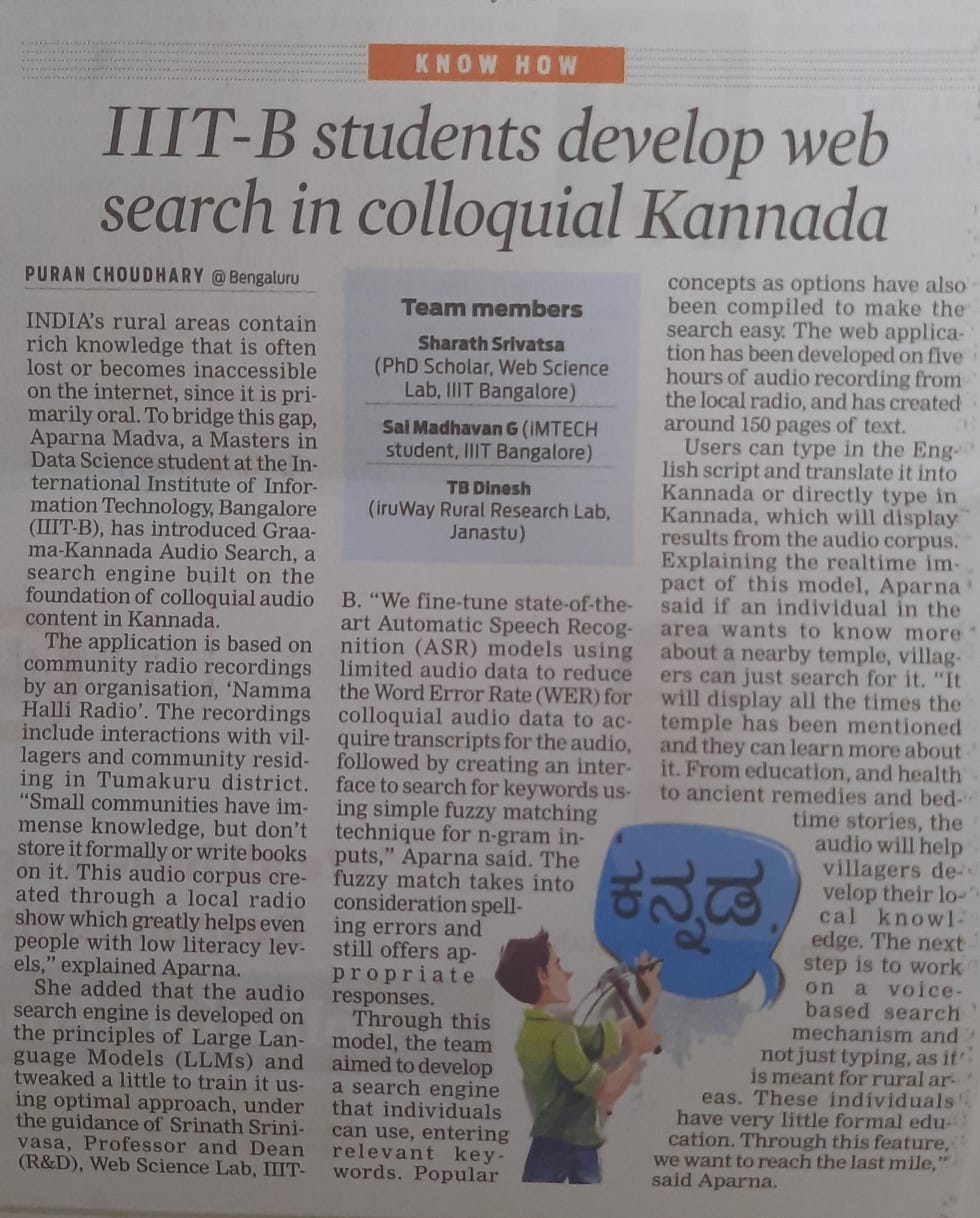
IndicNLP project focuses on building an knowledge management framework for oral community knowledge in low-resource and colloquial Kannada language.

Background

Knowledge in rural communities is largely created, preserved, and is transferred verbally, and it is limited. This information is valuable to these communities, and managing and making it available digitally with state-of-the-art approaches enriches awareness and collective knowledge of people of these communities. The large amounts of data and information produced on the Internet are inaccessible to the population in these rural communities due to factors like lack of infrastructure, connectivity, and limited literacy. Knowledge internal to rural communities is also not conserved and made available in any global Big Data information systems. Artificial Intelligence (AI) technologies such as Automatic Speech Recognition (ASR) and Natural Language Processing (NLP) provide substantial assistance when vast quantities of data, like Big Data, are available to build solutions. In the case of low-resource languages like Kannada and rural colloquial dialects, publicly available corpora are significantly less. Building state-of-the-art AI solutions is challenging in this context, and we address this problem in this work. Knowledge management in rural communities requires a low-cost and efficient approach that social workers can use. Organizations such as Namma Halli Radio have collected an audio corpus of a few hours containing community interactions spoken in colloquial language. We propose an architecture for oral knowledge management for rural communities speaking colloquial Kannada using audio recordings.

Funding Agency

Mphasis F1 foundation

Publications

Aparna, M., Srivatsa, S., Sai Madhavan, G., Dinesh, T.B., Srinivasa, S. (2024). AI-Based Assistance for Management of Oral Community Knowledge in Low-Resource and Colloquial Kannada Language. In: Sachdeva, S., Watanobe, Y. (eds) Big Data Analytics in Astronomy, Science, and Engineering. BDA 2023. Lecture Notes in Computer Science, vol 14516. Springer, Cham. https://doi.org/10.1007/978-3-031-58502-9_1

Sharath Srivatsa, Aparna M, Sai Madhavan G, and Srinath Srinivasa. 2024. Knowledge Management Framework Over Low Resource Indian Colloquial Language Audio Contents. In Proceedings of the 7th Joint International Conference on Data Science & Management of Data (11th ACM IKDD CODS and 29th COMAD) (CODS-COMAD ’24). Association for Computing Machinery, New York, NY, USA, 553–557. https://doi.org/10.1145/3632410.3632483 

Aparna M and Srinath Srinivasa. 2023. Active learning for Named Entity Recognition in Kannada. TechRxiv. Preprint. https://doi.org/10.36227/techrxiv.24580582.v1

Media Mentions

Demo

Graama-Kannada Audio Search webapp : http://103.156.19.244:33035/,
(username : guest, password : guest123)

Graama-Kannada demo video:

People

Research Scholars

Project Students

  • Goutham U R
  • Ram Sai Koushik Polisetti
  • Sai Madhavan G
  • Kappagantula Lakshmi Abhigna
  • Manuj Malik
  • Debmalya Sen
  • Vikram Adithya C P
  • Venumula Sai Sumanth Reddy

Consent Management in Digital Public Infrastructures

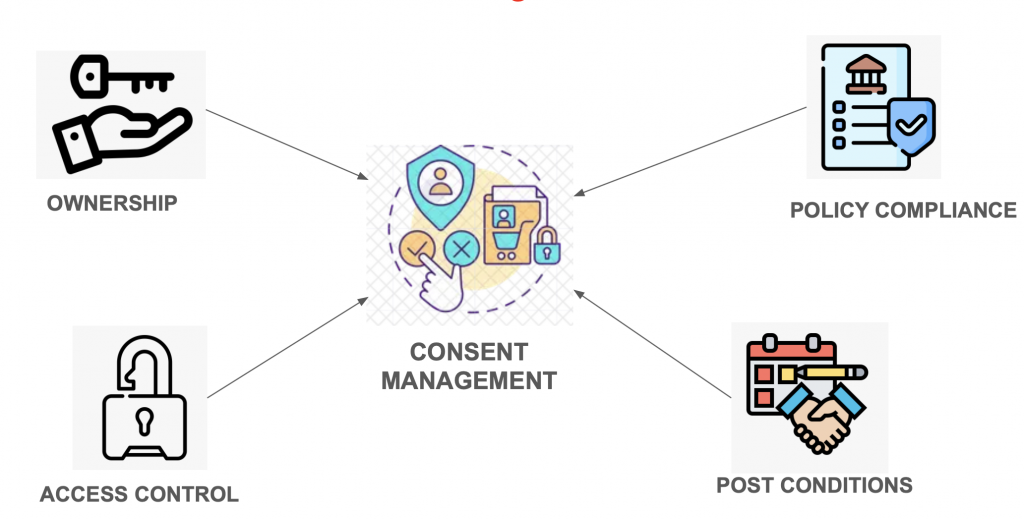
The primary aim of our work is to develop a formal framework to manage consent for open-ended data sharing use cases like Digital Public Infrastructures (DPIs). Our framework delves into philosophical, legal and technical aspects of consent to ensure a holistic solution. In this regard, we propose policy-based consent management which resolves consent across 4 key dimensions – ownership, policy compliance, access-control and post-access conditions. The prototype of the work can found at Anumati: Consent Management Service.

Other important aspects of the work include developing an architecture for cross-border data flows in DPIs , developing a consent ontology to understand meaningful consent policies.

Funding Agency

Centre of Data for Public Good (CDPG), IISc

Publications

  1. Ayappane, Balambiga, et al. “Extensible Consent Management Architectures for Data Trusts.” arXiv preprint arXiv:2309.16789 (2023).
  2. Rohith VaidyanathanSrinath SrinivasaPraseedaDev Shinde. Ownership and Flow Primitives for Scalable Consent Management in Digital Public Infrastructures. ArXiv pre-print 2511.02950 
  3. Balambiga Ayappane, Rohith Vaidyanathan, Srinath Srinivasa, Santosh Kumar Upadhyaya, and Srinivas Vivek. 2024. Consent Service Architecture for Policy-Based Consent Management in Data Trusts. In 7th Joint International Conference on Data Science & Management of Data (11th ACM IKDD CODS and 29th COMAD) (CODS-COMAD 2024), January 04–07, 2024, Bangalore, India. ACM, New York, NY, USA, 9 pages. https://doi.org/10.1145/3632410
  4. Asilata Karandikar. 2024. What Makes Consent Meaningful? In Companion Publication of the 16th ACM Web Science Conference (Websci Companion ’24). Association for Computing Machinery, New York, NY, USA, 42–46. https://doi.org/10.1145/3630744.3658616

Team Details

  1. Prof. Srinath Srinivasa (PI)
  2. Balambiga Ayappane (Phd Scholar) 
  3. Dev Shinde (MS Scholar)
  4. Asilata Karandikar (collaborating PhD Scholar) 
  5. Sachin Poojary (Developer)
  6. Meghana TM (Developer)
  7. Prof. V Sridhar (collaborator) 
  8. Prof. Srinivas Vivek (collaborator) 

Big Data Analytics for Policy Support

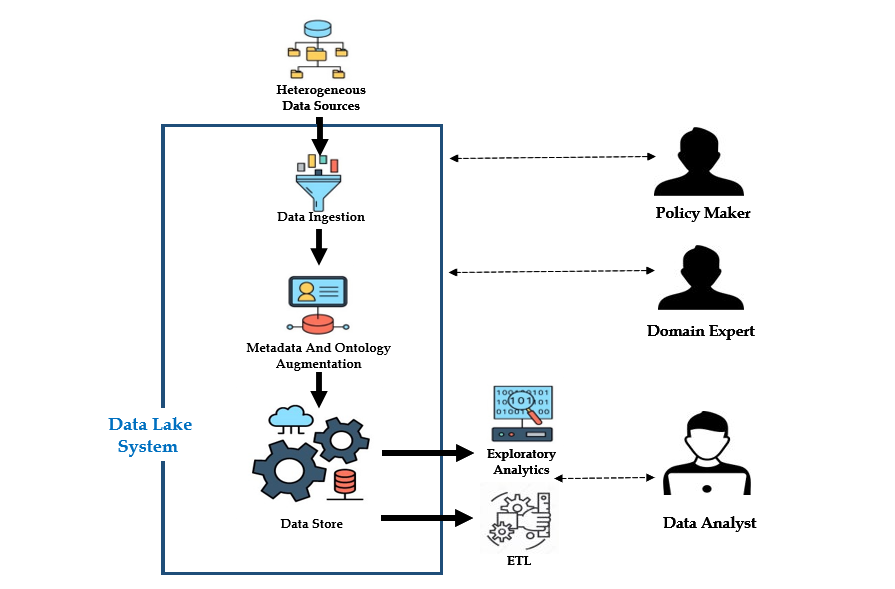
The primary focus of the Big Data Analytics for Policy Support project is to develop a sophisticated data management system that consolidates diverse documents from various government departments into a unified access point. This centralized hub serves as a valuable resource for policymakers, domain experts, and data analysts, allowing them to easily search and analyze documents through visual dashboards. The front-facing website of this work can be accessed at Karnataka Data Lake: Policy Research using Big Data Analytics.

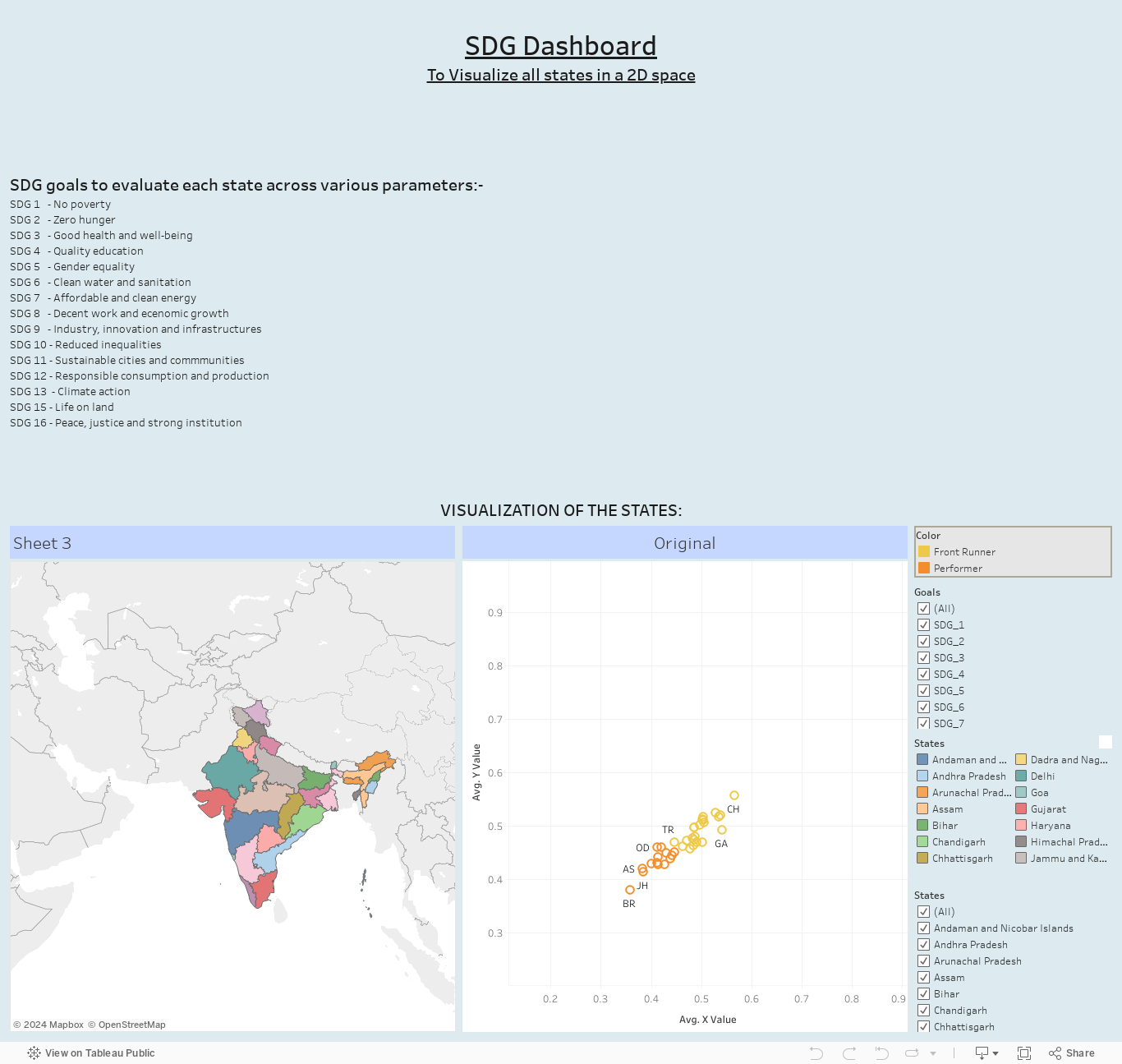
The other research direction of the project focuses on creating a comprehensive model library, which becomes a crucial asset for policymakers. This library not only aids in making informed decisions based on the current state but also looks ahead to anticipate future scenarios related to policy interventions. The ultimate aim of the Policy Support System (PSS) is to provide policymakers with a powerful tool that addresses current challenges related to Sustainable Development Goals (SDGs) while also proactively navigating the evolving landscape of policy dynamics.

The Architecture Diagram of Big Data Analytics for Policy Support

Publications

2025

2024

2023

2022

2021

People

Faculty

Research Scholars

Project Associates

Project Students

  • Nithin Raj
  • Omkar Lavangad
  • Phani Tirthala
  • Himesh Krishna Osuri
  • Anish Sai Potluri
  • Ayush Tiwari
  • Sowmith Nandan R
  • Arpitha Malavalli
  • Saiakash Konidena
  • Arjun Dutta
  • Akshay Girish Thite
  • Umang Okate
  • Gaurav Nilesh Tirodkar
  • Jasvin James Manjaly
  • Bhavil Sharma
  • Mallangi Siva Charan Reddy
  • Nimish Gaurish Sinai Khandeparkar
  • Gramya Gupta
  • Manish Reddy Koppula
  • Swadi Korattiparambil
  • Anant Pandey
  • Riya Patidar
  • Anuj Arora

Interns

  • Shreya Subramaniyam
  • Ojas Hegde
  • Greeshma Chandra Shekar
  • Nandan N
  • Sachin Tiwari
  • Siddharth Gautam
  • Sparsh Dalal
  • Rutvi Chavda
  • Mruga Patel

Research Site

Karnataka Data Lake: Policy Research using Big Data Analytics

Media Mentions

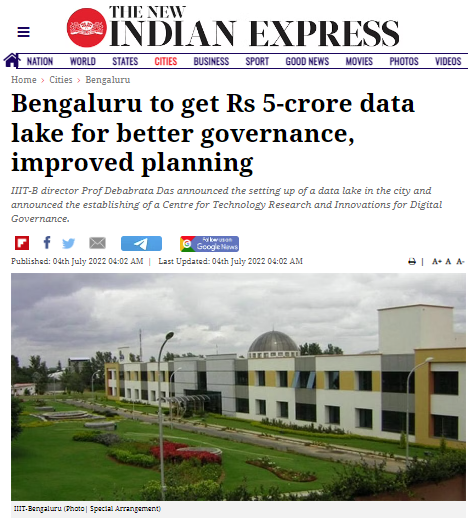
https://www.newindianexpress.com/cities/bengaluru/2022/jul/04/bengaluru-to-get-rs-5-crore-data-lake-forbetter-governance-improved-planning-2472616.html

Talks & Videos

  • Big-data-analytics in Astronomy, Science, and Engineering (BASE) 2021
  • MLN-DIVE Lecture Series: Srinath Srinivasa

Title: Diffusion and Perturbation Modeling for Policy Interventions

Date: June 11, 2022

https://psu.mediaspace.kaltura.com/media/MLN-DIVE+lecture+seriesA+Srinath+Srinivasa/1_mm4wvj58

  • Bangalore Tech Summit 16th – 18th November 2022

Miscellaneous

Thesis Reference Document for Intervention Modeling

Responsible Autonomy

Designing computational models of multi-agent autonomous systems which can act responsibly.

Funding Agency

Machine Intelligence and Robotics (MINRO)

Center for Internet of Ethical Things (CIET)

Publications

  1. Janvi Chhabra, Karthik Sama, Jayati Deshmukh, and Srinath Srinivasa. “Evaluating computational models of ethics for autonomous decision making”. In: AI and Ethics 2024 (Aug. 2024), pp. 1–14. issn: 2730-5961. https://doi.org/10.1007/s43681-024-00532-4 [pdf]
  2. Janvi Chhabra, Jayati Deshmukh and Srinath Srinivasa. 2024. Modelling the Dynamics of Subjective Identity in Allocation Games. In Proceedings of the 2024 International Conference on Autonomous Agents and Multiagent Systems (AAMAS ’24). [link]
  3. Karthik Sama, Jayati Deshmukh and Srinath Srinivasa. 2024. Social Identities and Responsible Agency. In Proceedings of the 2024 International Conference on Autonomous Agents and Multiagent Systems (AAMAS ’24). [link]
  4. Sama Sai Karthik, Jayati Deshmukh, Srinath Srinivasa. 2024. Transcending To Notions. Preprint. https://arxiv.org/abs/2401.12159 [link]
  5. Janvi Chhabra, Jayati Deshmukh, Srinath Srinivasa. 2024. Modelling the Dynamics of Identity and Fairness in Ultimatum Game. Preprint. https://arxiv.org/abs/2401.11881 [link]
  6. Jayati Deshmukh, Nikitha Adivi, and Srinath Srinivasa. 2023. Resolving the Dilemma of Responsibility in Multi-agent Flow Networks. In International Conference on Practical Applications of Agents and Multi-Agent Systems. Springer, 76–87. DOI: http://dx.doi.org/https://doi.org/10.1007/978-3-031-37616-0_7
  7. Janvi Chhabra, Karthik Sama, Jayati Deshmukh, and Srinath Srinivasa. 2023. When Extrinsic Payoffs Meet Intrinsic Expectations. In International Conference on Practical Applications of Agents and Multi-Agent Systems. Springer, 40–51. DOI: http://dx.doi.org/https://doi.org/10.1007/978-3-031-37616-0_4
  8. Jayati Deshmukh. 2023. Emergent Responsible Autonomy in Multi-Agent
    Systems. In Proceedings of the 2023 International Conference on Autonomous Agents and Multiagent Systems (AAMAS ’23). International Foundation for Autonomous Agents and Multiagent Systems, Richland, SC, 3029–3031. https://dl.acm.org/doi/abs/10.5555/3545946.3599161
  9. Jayati Deshmukh, Nikitha Adivi, and Srinath Srinivasa. 2023. Modeling Application Scenarios for Responsible Autonomy Using Computational Transcendence. In Proceedings of the 2023 International Conference on Autonomous Agents and Multiagent Systems (AAMAS ’23). International Foundation for Autonomous Agents and Multiagent Systems, Richland, SC, 2496–2498. https://dl.acm.org/doi/abs/10.5555/3545946.3598980
  10. Janvi Chhabra, Karthik Sama, Jayati Deshmukh, and Srinath Srinivasa. 2023. Comparative Modeling of Ethical Constructs in Autonomous Decision Making. (2023). DOI: http://dx.doi.org/https://doi.org/10.36227/techrxiv.21802302.v1
  11. Jayati Deshmukh and Srinath Srinivasa. 2022. Computational Transcendence: Responsibility and agency. Frontiers in Robotics and AI 9 (2022). DOI: http://dx.doi.org/https://doi.org/10.3389/frobt.2022.977303
  12. Srinath Srinivasa and Jayati Deshmukh. 2022. AI and the Sense of Self. arXiv preprint arXiv:2201.05576 (2022). DOI: http://dx.doi.org/https://doi.org/10.48550/arXiv.2201.05576
  13. Jayati Deshmukh, Srinath Srinivasa, and Sridhar Mandyam. 2021. What Keeps a Vibrant Population Together? Complex Syst. 30, 3 (2021), 347–373. DOI: http://dx.doi.org/https://doi.org/10.25088/ComplexSystems.30.3.347
  14. Srinath Srinivasa and Jayati Deshmukh. 2020. The Evolution of Computational Agency. In Novel Approaches to Information Systems Design. IGI Global, 1–19. DOI: http://dx.doi.org/https://doi.org/10.4018/978-1-7998-2975-1.ch001

Team Details

  1. Prof. Srinath Srinivasa
  2. Jayati Deshmukh [PhD Research Scholar]
  3. Janvi Chhabra [RE, PE, IMTech thesis, Jan 2022 – June 2023]
  4. Sama Sai Karthik [RE, PE, IMTech thesis, Jan 2022 – June 2023]
  5. Nikitha Adivi [PE, Aug 2022 – Dec 2022]

Videos

Webinar titled “Artificial Intelligence & Responsible Autonomy” by CSI ACM IEEE Chennai on January 29th, 2025

Samvaad talk at IIIT-B on August 22nd, 2022

Talk at Jijnasa 2021 on December 18th, 2021

Traffic Modeling and Simulation

Major research directions of the project are:

  • Simulations of traffic scenarios (like one-way, adding new roads, parking spots etc).
  • Experiments on Adaptive Traffic Lights.
  • Simulations to optimize traffic flows at network level.

Funding Agency

MINRO

Team Details

  • Jayati Deshmukh [PhD Research Scholar]
  • Karthik Ch [PE, Jan 2023 – May 2023]
  • Keshav Chandak [PE, Jan 2023 – May 2023]
  • Shubhanshu Agrawal [Summer Intern, PE, May 2022 – Dec 2022]
  • Manas Agrawal [PE, Aug 2022 – Dec 2022]
  • Shivankar Pilligundla [PE, Aug 2022 – Dec 2022]
  • Prakhar Rastogi [Summer Intern, May 2022 – July 2022]
  • Vijay Jaisankar [PE, Jan 2022 – May 2022]
  • Vignesh Bondugula [PE, Jan 2022 – May 2022]
  • Siva Jagadesh M [PE, Jan 2022 – May 2022]
  • Shashank Reddy [PE, Aug-Dec 2021]
  • Gayathri Venkatesh [PE, Aug-Dec 2021]
  • Manasa Kashyap [PE, Aug-Dec 2021]
  • Sriranjan S. [Summer intern, May-Jul 2021]
  • Ayush Yadav [PE, Jan-Apr 2021]
  • Rahul Murali Shankar [PE, Jan-Apr 2021]
  • Pratik Shastri [PE and IMTech thesis, Aug 2020-Jun 2021]
  • Divyanshu Khandelwal [PE, Aug-Dec 2020]

Code

Performing traffic interventions and running traffic simulations.

Activities

Demo presented at SUMO User Conference 2022. Won Best presentation based on live audience voting.

Demo of the project at Bangalore Tech Summit (BTS) 2020.